

does not make steel obsolete. Steel limits movement through high stiffness and low elongation. PET accepts more movement, absorbs short shocks, and can recover part of its elongation as a package settles. The better choice depends on what the load does after tensioning, not simply what it weighs.
The real PET strapping vs steel strapping decision is whether a complete PET system can replace the present steel arrangement without increasing movement, damage, production instability, or transport risk. It requires a defined load, known route, compatible equipment, and finished-package evidence.
Start with the Reason for Considering a Change
State the reason for conversion precisely. A plant may need to eliminate rust marks, reduce coil weight, remove sharp edges, improve tension retention on settling loads, or lower tool and seal costs. These are different projects. Record the present failure or cost before asking whether PET is better than steel.
Describe the Load after It Leaves the Strapping Station
Record mass, dimensions, center of gravity, rigidity, pallet quality, edges, surface sensitivity, and strap layout. Then follow the package through forklift handling, stacking, vibration, braking, container movement, and storage. Heavy-duty packaging is defined by this exposure and the consequence of restraint loss, not one weight threshold.
Loads that settle
Timber, cartons, bales, and some building products can lose height after packaging. PET may remain in contact because it can recover part of its elongation, while a rigid steel loop may become loose if the package contracts.
Loads that must remain rigid
Dense metal bundles, sharp-edged products, and loads exposed to heat or strict movement limits may continue to favor steel unless an engineered PET system is proven for the exact conditions.
Compare the Behavior of the Finished Loops
Catalog breaking force describes an unjointed specimen unless the supplier states otherwise. The package depends on a closed loop that includes a weld, seal, or buckle. Compare the tested jointed loop, achievable application tension, tension remaining after dwell, strap placement, and edge condition. A PET grade with a lower headline break figure may control a settling load more consistently, while steel may remain preferable when very low elongation is essential.
Use a Decision Table without Turning It into a Shortcut
The matrix below identifies which material normally deserves the first trial. It is not a cargo-weight chart and does not replace package testing. A demanding load may require additional protection, more than one strap direction, or a different restraint method regardless of the material selected.
| Packaging condition | PET deserves priority when | Steel remains a strong candidate when |
| Load response | The pack settles or experiences repeated shock | The pack must remain rigid with minimal elongation |
| Edges and surface | Corners can be protected and marking must be limited | Edges are abrasive and cannot be adequately isolated |
| Environment | Moisture or corrosion staining is a concern | High temperature exceeds the approved PET condition |
| Handling | Lower coil weight and smoother edges improve routine handling | Existing steel controls and trained procedures remain necessary |
| Equipment | A validated PET tool and joint can run consistently | Conversion would create an unverified closure or line constraint |
| Approval boundary | A representative PET pack passes defined tests | A rule, customer specification, or failed trial requires steel |
Examine Corners before Increasing Strap Strength
A sharp edge can cut PET before the strap body reaches its rated force. Steel tolerates some abrasive contact better, but it can also score coated products, crush carton edges, or create sharp cut ends. Map every contact point and note where the band may migrate during handling. Corner protectors must match the strap width, stay in position, and spread pressure without creating a new bending point.
Treat Safety as an Operating Condition
PET is lighter and has no metal edge, which can make coil handling and routine removal easier. It still stores energy under tension and can recoil when cut. Steel can produce sharp ends and a more severe spring-back hazard, so gloves, eye protection, controlled cutting, and exclusion from the strap line remain important. Compare actual tasks: unloading coils, threading tools, clearing faults, cutting straps, and collecting waste.
Price the Conversion at Package Level
Calculate strap length per accepted package, joint consumables, protectors, coil changes, tool maintenance, labor, scrap, and damaged shipments. PET may reduce coil handling and eliminate metal seals in a friction-weld system, while new tools, training, or additional protectors may offset part of the saving.
Count downtime as a packaging cost
Record feed faults, weak joints, battery changes, coil changeovers, and re-strapping. A material that appears cheaper can be expensive when it interrupts a high-output line.
Check Equipment before Ordering Production Coils
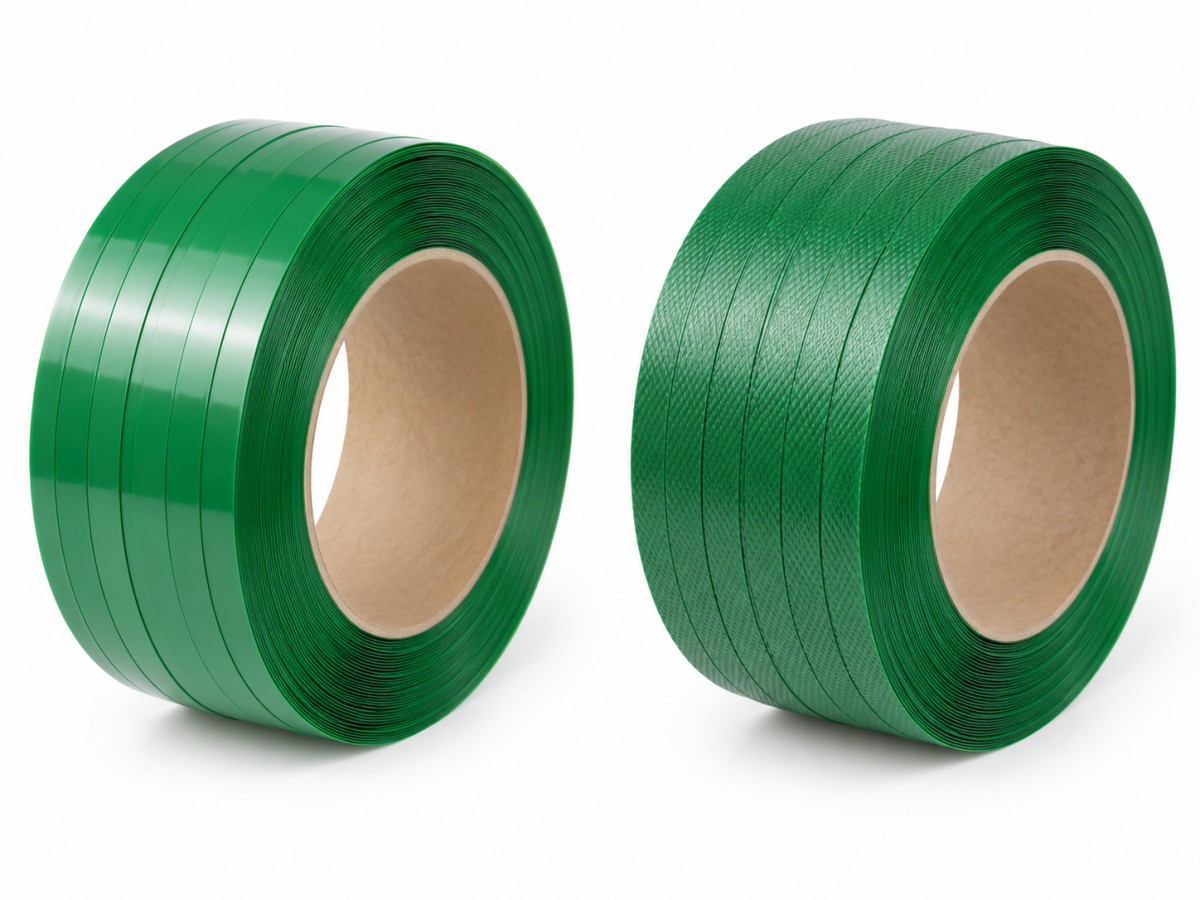
A PET band must fit the tool’s approved width and thickness range and produce a repeatable friction weld, heat seal, or approved mechanical joint. Guides, grippers, cutters, tension programs, core diameter, coil width, and dispenser braking also matter. The Zhuori product page presents PET strapping for both light and heavy loads and lists smooth and embossed surfaces; the exact proposed grade still needs to be matched to the customer’s equipment and closure method.
Run a Paired Trial instead of a Demonstration
Document the current steel package: strap size, loop layout, setting, joint, protectors, condition, and damage history. Prepare matched loads with a named PET grade and its approved setup. Do not copy steel tension to PET or assume the same loop count is correct.
Inspect after a dwell period
Recheck strap contact, joint condition, corner compression, package height, and visible movement after the load has settled.
Test the real handling sequence
Include normal forklift entries, stacking, braking or vibration exposure, and the longest relevant storage interval. A bench pull alone cannot reproduce the package system.
Define When the Conversion Must Stop
A trial should have rejection criteria before the first pack is made. Stop if a joint slips, a strap migrates, an edge begins to cut the band, the load shifts beyond the agreed limit, the package is crushed, or the equipment cannot maintain repeatable cycles. Steel should remain in use when a customer rule, transport requirement, temperature, edge condition, or consequence of failure falls outside the validated PET system.
Write the Final Decision as a Controlled Specification
If PET is approved, record its grade, dimensions and tolerances, surface, mechanical requirement, coil details, tool program, joint acceptance, loop layout, protectors, and approved load family. Attach the trial record and list changes that trigger revalidation. This prevents a controlled conversion from becoming an instruction to use any green plastic strap.
Conclusion
PET often suits settling loads, corrosive environments, frequent coil handling, and applications with a controlled welded joint. Steel remains justified where rigidity, edge resistance, temperature, governing requirements, or failure consequences exceed the proven PET system. The decision should follow the load and route, not a general strength claim.
Assess Guangzhou Nansha District Youjian Plastic Co., Ltd. through the exact proposed grade, while approving the complete package. A paired trial, rejection limits, and a controlled specification provide stronger evidence than a demonstration.
FAQ
Can PET strapping replace steel on every heavy load?
No. PET can replace steel in many applications, but sharp edges, high temperature, extreme rigidity requirements, customer rules, or an unsuccessful package trial may require steel.
Is steel always stronger than PET strapping?
Steel generally offers greater stiffness and can provide higher absolute capacity, but installed performance also depends on the joint, applied tension, retained tension, strap layout, and load behavior.
Should the same tension setting be used after switching to PET?
No. PET and steel have different operating characteristics. Use compatible equipment and establish an approved PET setting through controlled trials.
What information is needed before requesting a PET trial?
Provide load weight and dimensions, product and pallet details, edge condition, present steel specification, strap layout, tools, route, storage exposure, and acceptance criteria.
Post time: Oct-17-2026


