

Width and thickness answer different engineering questions. Width controls how the force is spread across the package and whether the strap can pass through the machine. Thickness changes cross-sectional area, stiffness, coil yield, and the energy needed to form a dependable joint. A buyer who treats either number as a simple proxy for quality can end up with a stronger-looking strap that runs badly or marks the load.
Selecting PET strapping band width and thickness begins at the package and travels backward through the joint and equipment to the roll. A useful specification states what the band must do, which dimensional window the line can accept, and how variation will be measured when material arrives.
Begin at the Package Surface
Define the load type, packed weight, strap layout, transport shocks, storage exposure, edge condition, and permitted package compression. This prevents a dimension-first purchase that may be unnecessarily expensive or operationally incompatible.
Width Determines Bearing Area and Machine Fit
A wider strap spreads force across a larger contact area. That can reduce pressure on cartons or boards and may support a higher break rating, but only when the material grade and thickness are also suitable. Width must fit every guide, feed channel, gripper, cutter, and weld component in the machine.
Narrower widths
They can provide more metres per coil and work well on smaller packages, but demand careful confirmation of break strength and surface pressure.
Wider widths
They are common in heavier applications and provide more bearing area, although they may require different tools and protectors.
Thickness Changes Stiffness as Well as Capacity
Increasing thickness generally raises cross-sectional area and stiffness, but it also reduces length per coil at a similar coil weight. Excessive stiffness can impair bending around small corners or feeding through equipment. The exact result depends on resin, orientation, embossing, and process consistency, so thickness alone is not a strength certificate.
Use Cross Section as a Check, Not a Verdict
The official Zhuori PET pages publish a broad width range, with one page listing 9–32 mm and 0.60–1.27 mm. A second page provides common combinations and pull-force figures. Those values are useful for initial screening, but the exact ordered grade should be confirmed on its own data sheet.
Build a Dimensional Shortlist
The following matrix summarizes the decision logic without assigning an unverified cargo limit to a dimension.
| Candidate dimension | Typical screening role | What must be verified |
| 9–12 mm | Compact bundles and lighter restraint tasks | Break load, edge pressure, machine path |
| 15–16 mm | General pallet and medium-to-heavy applications | Joint strength, retained tension, tool range |
| 19 mm | Heavier or more demanding pallet loads | Corner protection, weld quality, coil handling |
| 25–32 mm | High-capacity candidates requiring dedicated review | Equipment compatibility and full package validation |
Attach a Mechanical Result to Each Size
Two straps with the same nominal dimensions may not have the same breaking load. Request the actual minimum or guaranteed value, test method, elongation, tolerance, and lot traceability. Distinguish newtons from kilogram-force and do not copy a number between units without conversion.
Include Surface Finish in the Trial
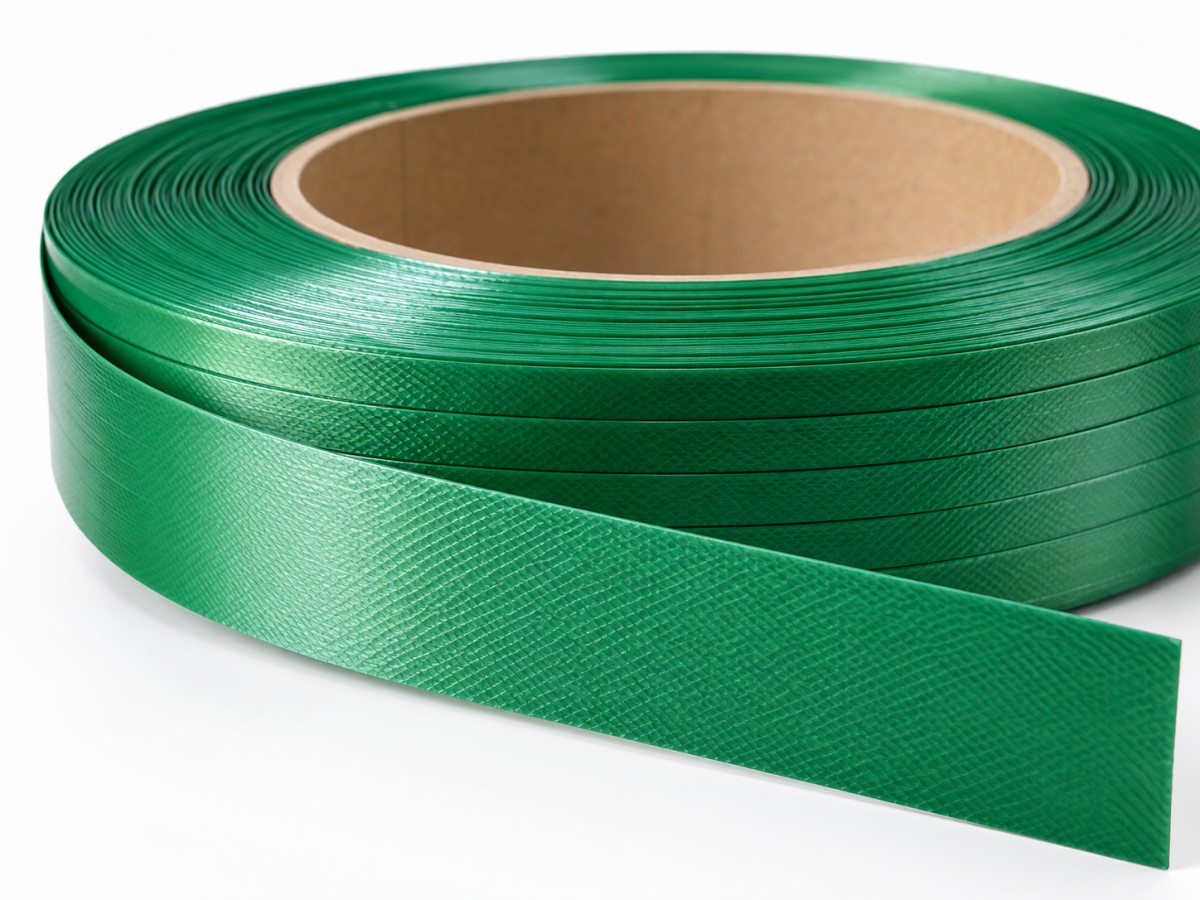
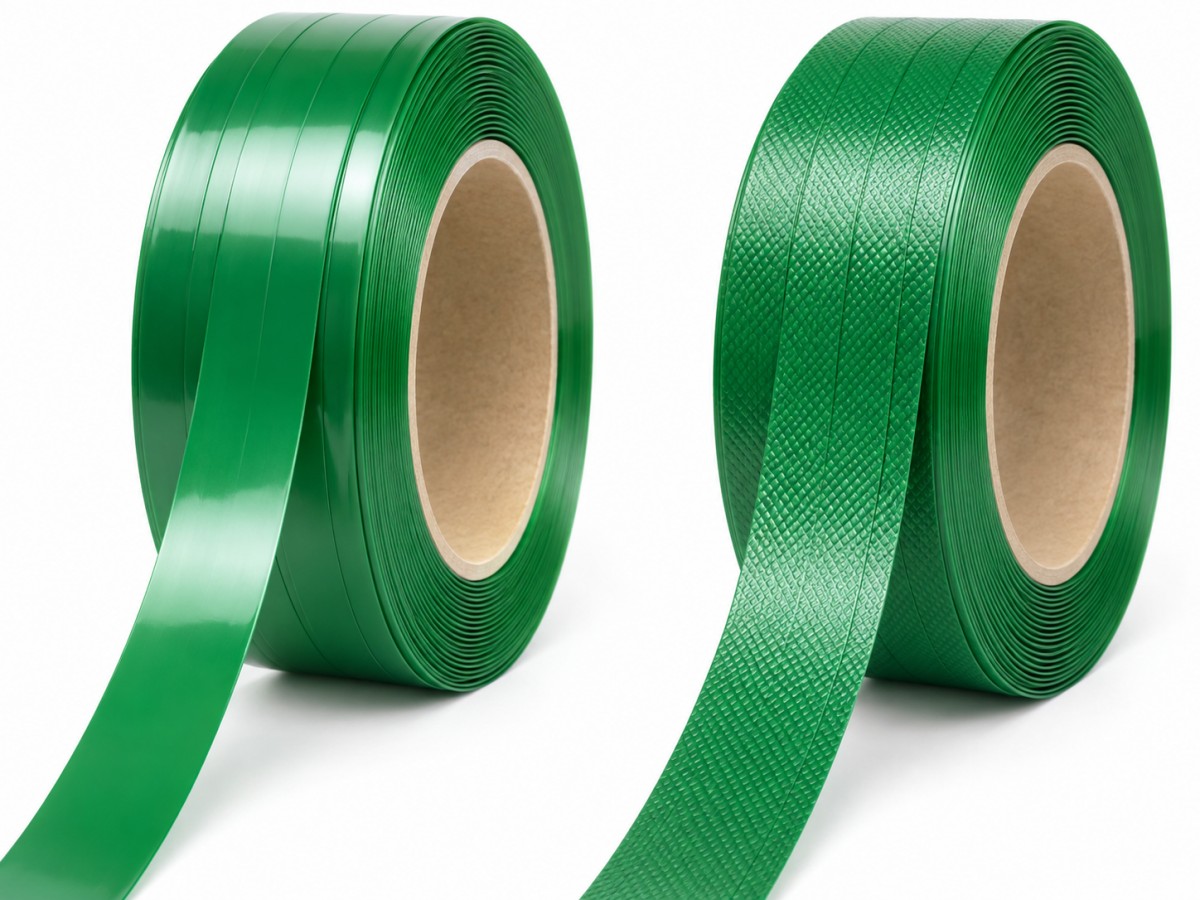
Smooth and embossed PET are both listed on the company product page. Surface texture can affect feeding, grip, friction welding, and contact marking. Test the proposed surface with the intended battery tool, pneumatic tool, heat seal, friction weld, or buckle system rather than assuming one finish is universally better.
Inspect the weld
A consistent joint should show repeatable fusion across the approved overlap without burn-through, peeling, or contamination.
Measure the whole loop
Parent-strap strength does not compensate for a weak joint, damaged edge, or misaligned tool.
Specify the Roll That Production Will Receive
Specify core diameter, coil width, winding pattern, coil weight, dispenser arrangement, and dimensional tolerance. Stable winding and low camber matter especially in automatic lines. A dimensionally suitable strap that telescopes or wanders can still cause downtime.
Reject the Biggest Is Safest Assumption
Selecting the widest and thickest option can reduce coil length, increase material consumption, overload packages, and force equipment changes. Select the lowest specification that passes the approved package test with an appropriate margin and stable production results.
Set Measurement Rules before Ordering
Nominal dimensions are incomplete without tolerances. Agree on how width and thickness will be measured, how many samples represent a lot, and what result triggers quarantine or investigation. Small dimensional shifts can change stiffness, feed behavior, applied tension, and friction-weld energy even when the printed size remains unchanged.
Require notification before a change to resin blend, embossing pattern, colorant, core, winding method, or production route when it may affect equipment or package performance. Run a candidate at normal production speed, not only through one slow cycle. Observe feed alignment, tension repeatability, weld appearance, cutter performance, coil changeover, scrap, and heat buildup during a representative shift.
Calculate Yield at Package Level
A wider or thicker strap normally provides fewer metres per coil and can increase material consumption, coil changes, and package pressure. A lighter grade can also be costly if it creates joint rejects, downtime, or transit damage. Compare metres per accepted package, labor, protectors, waste, maintenance, and damage risk rather than judging price per coil alone.
The best choice is usually the lowest specification that consistently passes the approved package test with an appropriate margin. That decision should be supported by production records and monitored shipment results, not a dimension shortcut.
Conclusion
PET strapping band width and thickness should be selected as one measurable system. Screen dimensions against the load and contact area, verify the exact break rating, confirm the joint and machine window, then approve the choice through a representative trial. Guangzhou Nansha District Youjian Plastic Co., Ltd. can provide candidates within the published PET range, but the result should be a controlled application specification rather than a generic size recommendation.
Keep the approved roll code, tolerances, coil details, tool settings, joint method, protector, strap layout, and trial result together. This makes procurement changes visible and gives operators a stable reference when a new lot or machine begins to behave differently.
FAQ
Is 16 mm PET strapping suitable for every pallet?
No. It is a common size, but suitability depends on grade, thickness, break load, joint, strap count, tension, edges, and route.
Does thicker PET always have higher strength?
Often, but resin quality, orientation, processing, and dimensions all matter. Use the tested breaking load for the exact grade.
Can a machine run any PET width?
No. Guides, feeders, grippers, cutters, and weld heads have approved dimensional ranges.
Should smooth or embossed PET be selected?
Choose according to the equipment, joint process, surface contact, and verified trial results rather than appearance alone.
Post time: Oct-16-2026


